Beyond the Reference Photo: Creating Wildlife Art That Tells a Story
 Kerri Dixon

Go beyond the reference photo! Learn how wildlife research, storytelling and composition can inspire more meaningful, creative artwork.
Beyond the Reference Photo: Creating Wildlife Art That Tells a Story
Have you ever come across a beautiful photograph of an animal and immediately thought, "Oh, I'd love to paint that!"
I certainly have!
In fact, I think most wildlife artists begin their paintings this way. We see an animal with a lovely expression, beautiful lighting or interesting colours, and we can already imagine how wonderful it would look in pastel.
And there's absolutely nothing wrong with that.
But lately, I've been thinking about what happens when we go a little further.
What if, instead of simply choosing a photograph because we like the way it looks, we spend some time learning about the animal itself?
Where does it live? What does it do? What makes it special? And perhaps most importantly, what is it about this particular animal that makes us want to paint it?
Because sometimes, the most interesting part of a wildlife painting isn't what we can see in the reference photograph.
It's the story behind it.
A Reference Photograph Is Just the Beginning
When we're learning to draw or paint realistically, reference photographs are incredibly valuable.
They help us understand anatomy, proportions, colour, texture and lighting. And when you're painting wildlife, particularly animals that don't tend to sit still for very long, they're practically essential!
But there's a difference between using a photograph as a reference and allowing it to make every artistic decision for us.
When we copy a photograph exactly, we're accepting all the decisions that the photographer made.
The angle, the lighting, the background, the composition and even the moment that was captured.
Sometimes those decisions are wonderful, and the photograph makes a beautiful painting just as it is.
Other times, though, there might be an opportunity to create something quite different.
Perhaps the background is distracting. Maybe the animal would look more interesting with a little more space in front of it. Or perhaps you've discovered something about its behaviour that suggests an entirely different composition.
That's when we start moving beyond simply reproducing a photograph and begin creating artwork with our own artistic intention.
And I think that's a really exciting part of developing as an artist.
Getting to Know Your Subject
One of the things I love about painting wildlife is that I always seem to learn something along the way.
Sometimes it's something as simple as discovering why an animal has a particular marking or how its fur changes colour in different lighting.
Other times, I find myself going down a rabbit hole, researching its habitat, behaviour and conservation status.
Before beginning a wildlife painting, there are a few things worth investigating.
1. Where does the animal live?
Understanding an animal's habitat can open up all sorts of possibilities for your artwork.
Does it live in dense rainforest, open grassland, desert or coastal dunes?
What plants, trees and natural features are part of its environment?
You don't necessarily have to include all those things in your painting, but knowing about them gives you choices.
2. How does the animal behave?
This is where things get really interesting.
Is it a solitary animal or does it live in a group? Is it curious, cautious, playful or territorial?
Does it hunt, forage, climb, glide or spend most of its time sleeping?
Understanding behaviour can help you choose a pose or moment that tells us something about the animal rather than simply showing us what it looks like.
3. What makes this animal special?
Every species has characteristics that make it unique.
It might be an unusual adaptation, a fascinating behaviour or a particular relationship with its environment.
Sometimes discovering just one interesting fact can completely change the direction of a painting.
4. Why do I want to paint it?
This might be the most important question of all.
Is it because you love the animal? Because you've encountered one in the wild? Because you're fascinated by its behaviour?
Or perhaps you've learned something about the challenges it faces and want to share that story.
Your reason doesn't have to be complicated or profound.
But understanding what attracted you to the subject can help you decide what you want your artwork to communicate.
6acd7ed7eef4e_lg.jpg)
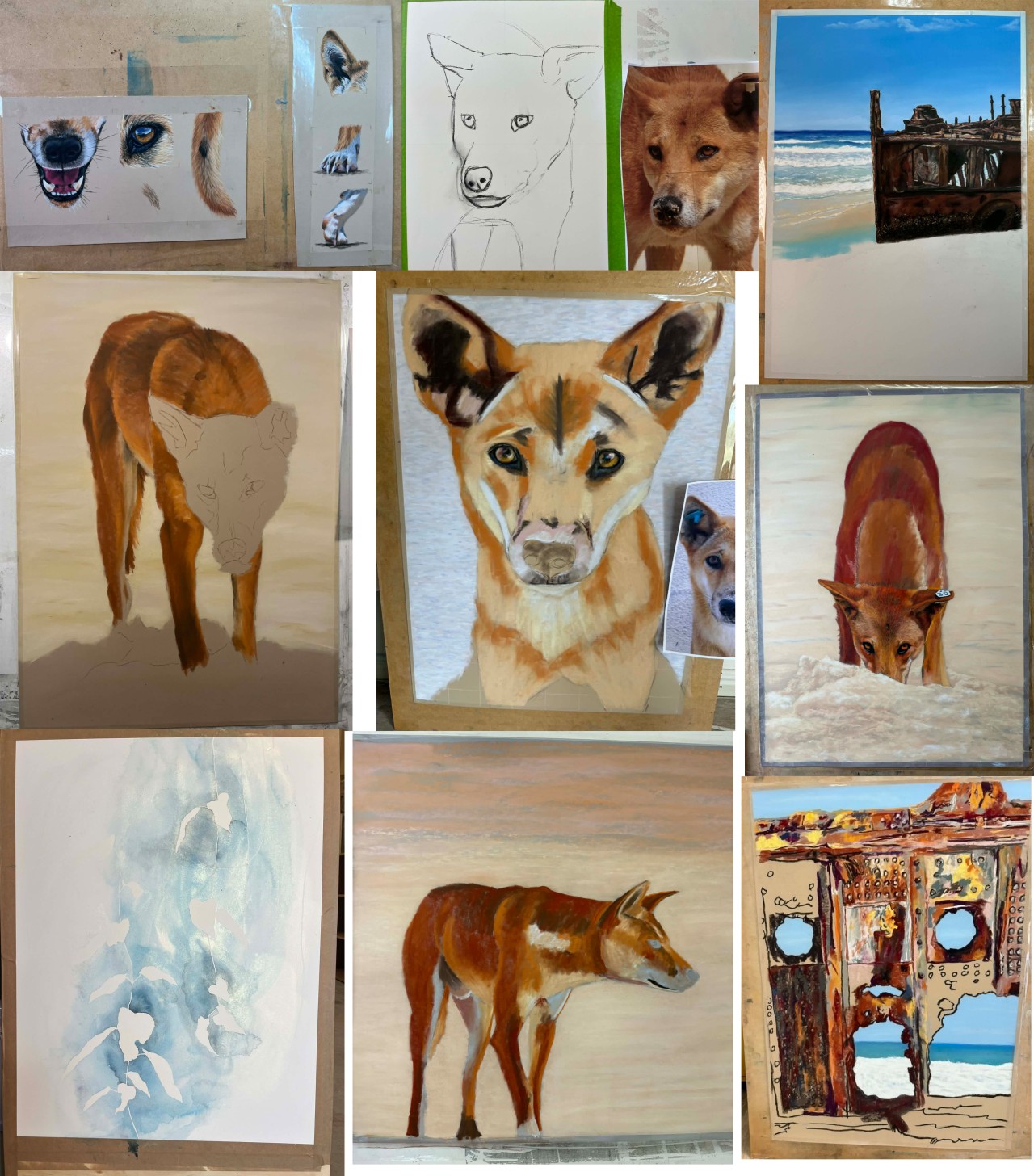
My Colours of K'gari Dingo Series
A good example from my own work is my Colours of K'gari series.
I've spent quite a bit of time photographing and observing the dingoes on K'gari (Fraser Island), and the more time I spend with them, the more fascinated I become.
Of course, I could simply paint a lovely portrait of a dingo.
And sometimes that's exactly what I want to do!
But watching their behaviour and learning about their environment has given me ideas for paintings that go beyond a traditional wildlife portrait.
In Keeping Watch, I wanted to capture that sense of awareness as a dingo searched the sand for fish heads while keeping an eye on its surroundings.
In Locked On, it was the intensity of the dingo's focus that interested me.
And in my Closing the Distance triptych, I explored the movement of a dingo walking towards the photographer across three separate artworks.
These paintings are all about the same animal, but they communicate different things.
One tells us something about behaviour. Another focuses on expression and intensity. And another explores movement and the relationship between the animal and the viewer.
That's one of the wonderful things about developing a series.
You don't need a different subject for every painting. Sometimes one subject has dozens of stories waiting to be told.
The Greater Gliders on Our Farm
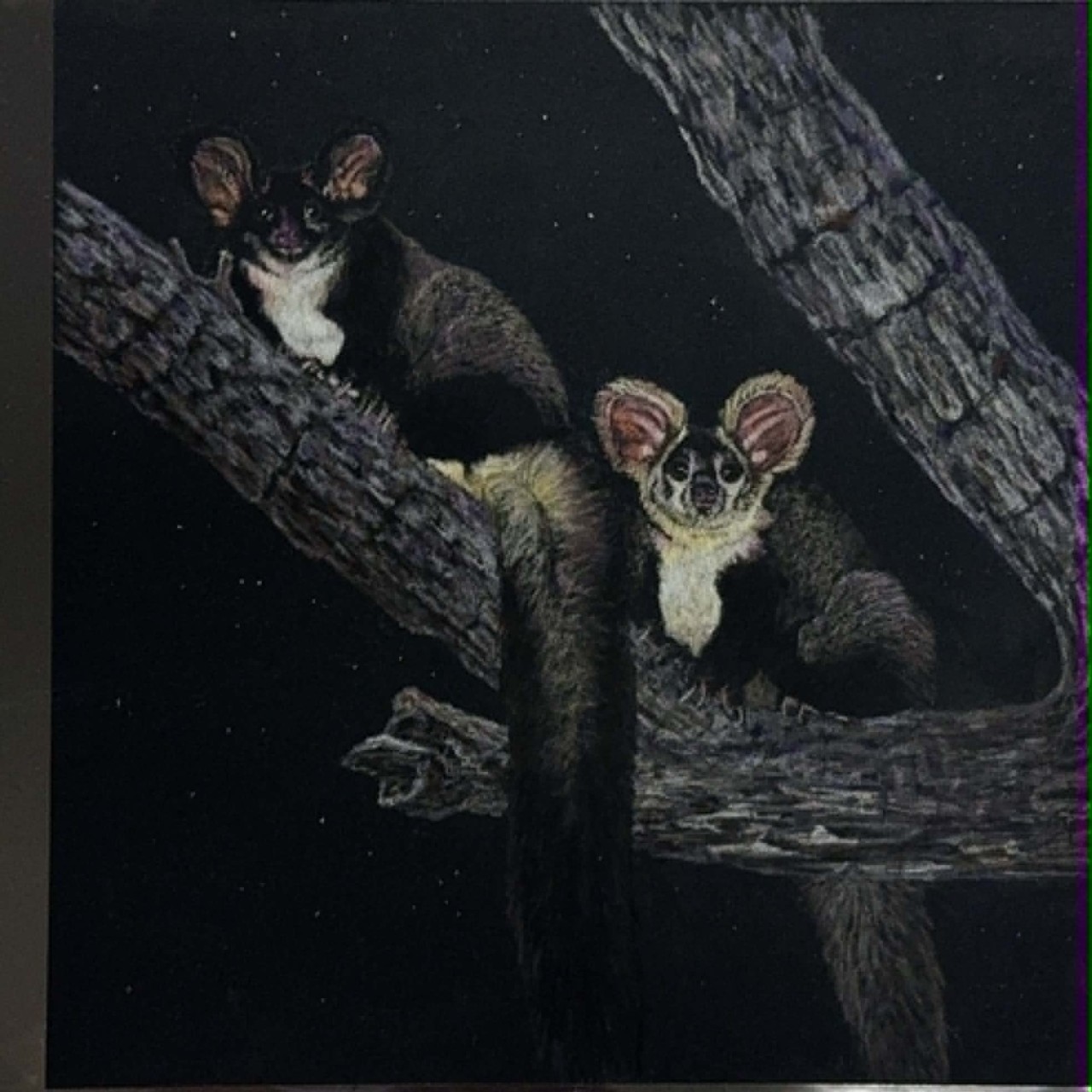
Another animal I've become particularly interested in is the Greater Glider.
We're fortunate enough to have these beautiful creatures living on our property, which makes them especially meaningful to me.
Greater Gliders are nocturnal marsupials that spend much of their lives in trees. They rely on tree hollows for shelter and use their gliding membranes to travel between trees.
They're also threatened by habitat loss and other pressures, which makes the protection of their forest habitat particularly important.
Now, imagine I found a beautiful close-up photograph of a Greater Glider.
I could paint a lovely portrait showing its enormous fluffy ears, round face and beautiful fur.
But after researching the species, I might decide that the tree itself is an important part of the story.
Perhaps I could paint a glider emerging from a hollow in an old eucalyptus tree.
Or I might create a nighttime scene, with the glider perched on a branch, surrounded by the darkness of the forest.
Maybe I could explore the contrast between its soft fur and the rough bark of the tree.
Suddenly, instead of having one idea for a painting, I've got several.
And those ideas have come from learning more about the animal rather than simply looking for another pretty photograph.
That's the real value of research.
It gives us more to work with.
Turning Research Into Artistic Decisions
Of course, researching your subject is only half the process.
The next step is deciding how to translate what you've learned into a painting.
And this is where all those artistic elements we practise — composition, values, edges, colour and lighting — become so important.
Composition: Where Do You Want the Viewer to Look?
Think about what you want the viewer to notice first.
If it's the animal's expression, you might choose a close-up portrait with very little background.
If it's the relationship between the animal and its environment, you might pull back and include more of the habitat.
You can also use cropping, negative space and the rule of thirds to make your composition more interesting.
I often use Procreate to experiment with reference photographs before starting a painting.
It's a wonderful way to move things around, try different crops and see how even a small adjustment can change the feeling of an image.
Lighting: What Mood Are You Creating?
Lighting does so much more than help us describe form.
It creates atmosphere.
A brightly lit animal against a simple background might feel cheerful and energetic.
The same animal emerging from deep shadows could feel mysterious or dramatic.
Soft, warm light might create a sense of peace, while strong contrasts can add tension or intensity.
Of course, when working realistically, we need to understand how light behaves. We can't simply put highlights and shadows wherever we like!
But by gathering suitable references and understanding our subject's form, we can make more deliberate lighting choices.
Colour: What Feeling Do You Want to Convey?
Colour can also influence the mood of a painting.
Perhaps you want the warm earthy colours of the Australian bush.
Or the cool blues and greens of a shaded rainforest.
You might decide to simplify the colours in your background so the animal becomes the focal point.
And remember, you don't have to include every colour you see in the photograph.
Sometimes leaving something out is just as important as putting something in.
Edges and Detail: What Really Matters?
This is something I talk about quite often in my tutorials.
Not everything needs the same level of detail.
If the animal's eyes are the most important part of the painting, perhaps that's where you want your sharpest edges and strongest contrasts.
Other areas can be softer and less defined.
By controlling where we place our detail, we're helping the viewer understand what matters most.
We're telling them where to look.
Try Creating Three Compositions Before You Paint
Here's a little exercise that I think could be really valuable.
The next time you find an animal you'd love to paint, don't rush straight into transferring the outline onto your Pastelmat.
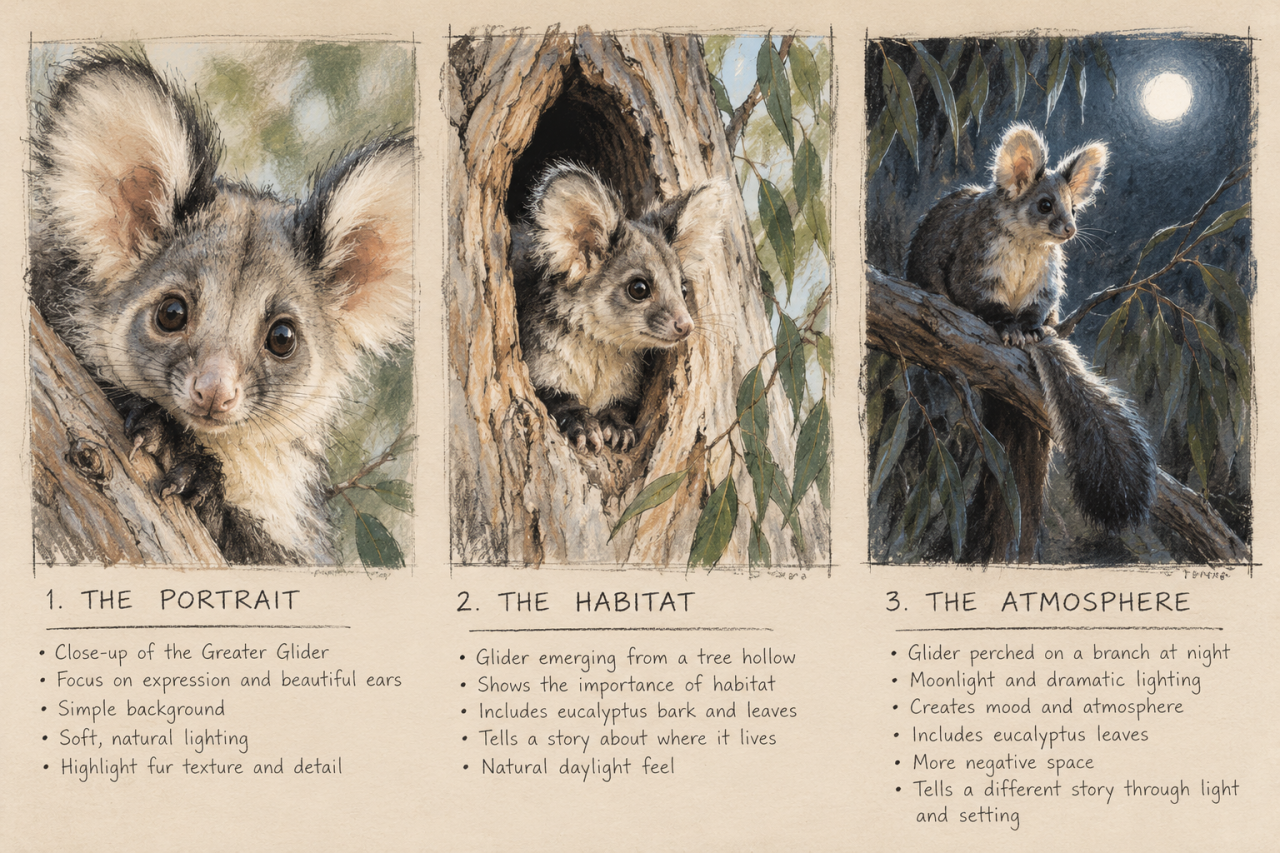
Instead, spend a little time researching the subject and then create three small thumbnail sketches.
They don't need to be beautifully drawn. In fact, the rougher and quicker they are, the better!
You're simply exploring possibilities.
For example, if you were painting a Greater Glider, you might try:
Composition One: The Portrait
A close-up of the glider's face, focusing on its expression, eyes and soft fur.
Composition Two: The Habitat
The glider emerging from a tree hollow, with the bark and surrounding forest helping to tell the story.
Composition Three: The Atmosphere
A nighttime scene with the glider perched on a branch, using dramatic lighting and plenty of negative space.
Same animal. Three very different paintings.
And perhaps, after sketching those ideas, you'll discover that the composition you like best isn't the one you originally imagined.
That's exactly what this exercise is about.
Could One Subject Become a Whole Series?
Once you start thinking this way, it's quite easy to see how one animal could inspire an entire series.
You might create a collection exploring different behaviours.
Or a series showing an animal in different seasons or environments.
Perhaps you could focus on different aspects of its personality, movement or relationship with other animals.
You could even explore the same subject through different compositions, colour palettes or lighting conditions.
A series doesn't have to be enormous, either.
Three paintings can be enough to explore an idea.
And working on several pieces around the same subject can be a wonderful way to develop your artistic voice.
You become more familiar with the animal's anatomy, colours and textures, which frees you up to concentrate on the creative decisions.
Rather than starting from scratch every time, you're building on what you've already learned.
A Quick Word About Reference Photographs and Copyright
Because we're talking about researching wildlife and gathering references, I also want to mention something important.
Finding a photograph on Google, Pinterest or social media doesn't automatically mean we have permission to use it for a painting.
Photographs are generally protected by copyright, and that includes wildlife photographs.
If you're planning to reproduce a photograph closely, particularly in artwork you intend to sell, exhibit or turn into prints, make sure you have the appropriate permission or licence.
There are some wonderful sources of properly licensed reference photographs, including images released under Creative Commons licences, but it's important to check the conditions of each individual image.
And remember, using several photographs to research anatomy, habitat and behaviour is different from simply assuming that changing a few details makes a copyrighted photograph free to use.
I always encourage artists to work from their own photographs whenever possible or use references they have permission to work from.
It's also worth remembering that having permission to use a photograph and making creative decisions about your artwork are two separate things.
Both are important.
You Don't Have to Tell a Grand Story With Every Painting
Now, before you start thinking that every painting needs a deep meaning or a conservation message, I want to make something clear.
It doesn't!
Sometimes you just want to paint a gorgeous animal because you love the colours, the texture or the expression.
And that's a perfectly good reason.
Not every zebra needs a mission statement!
But I do think there's something valuable about occasionally slowing down and asking ourselves a few more questions before we begin.
Why this animal?
Why this pose?
Why this composition?
What do I want people to notice or feel when they look at the finished painting?
Those questions can help us become more intentional with our artwork.
And often, that's where our own artistic style begins to develop.
Your Creative Challenge
This week, I'd love you to choose an animal that interests you.
It could be something you've always wanted to paint, a bird that visits your garden, a pet, or perhaps a threatened species from your local area.
Spend 15 or 20 minutes learning something about it.
Look beyond its appearance. Find out about its behaviour, habitat or something unusual that makes it special.
Then, before beginning a finished painting, sketch out three different composition ideas.
Think about what each one might communicate.
You don't have to paint all three. You don't even have to paint any of them straight away!
The exercise is simply about exploring possibilities and discovering how research can influence your creativity.
And if you do turn one of those ideas into a finished artwork, I'd love to hear the story behind it.
Final Thoughts
As wildlife artists, we have a wonderful opportunity to share our fascination with the natural world.
Sometimes that means creating a beautiful portrait.
Sometimes it means capturing a particular behaviour or moment.
And sometimes it means telling a story that helps someone see an animal in a completely different way.
The more we learn about our subjects, the more possibilities we discover.
So next time you find a reference photograph that makes you reach for your pastels, perhaps spend a little time getting to know the animal first.
You never know where that curiosity might lead.
Because a reference photograph shows us what an animal looks like. Research helps us discover the story we want to tell.
Happy creating!
Kerri
Wildlife & Nature Artist | The Creative Barn
Want to develop your wildlife drawing and pastel skills?
Inside The Creative Barn Membership, I help artists build their skills in drawing and soft pastels, from understanding values and proportions through to creating realistic wildlife artwork.
Whether you're returning to art after years away or simply want to enjoy your creative time and keep learning, I'd love to help you along the way.