Book review - Keep Going by Austin Kleon
 Kerri Dixon
A look at Austin Kleon’s Keep Going and simple ways to stay creative, find inspiration, enjoy making art and keep going when life gets busy.
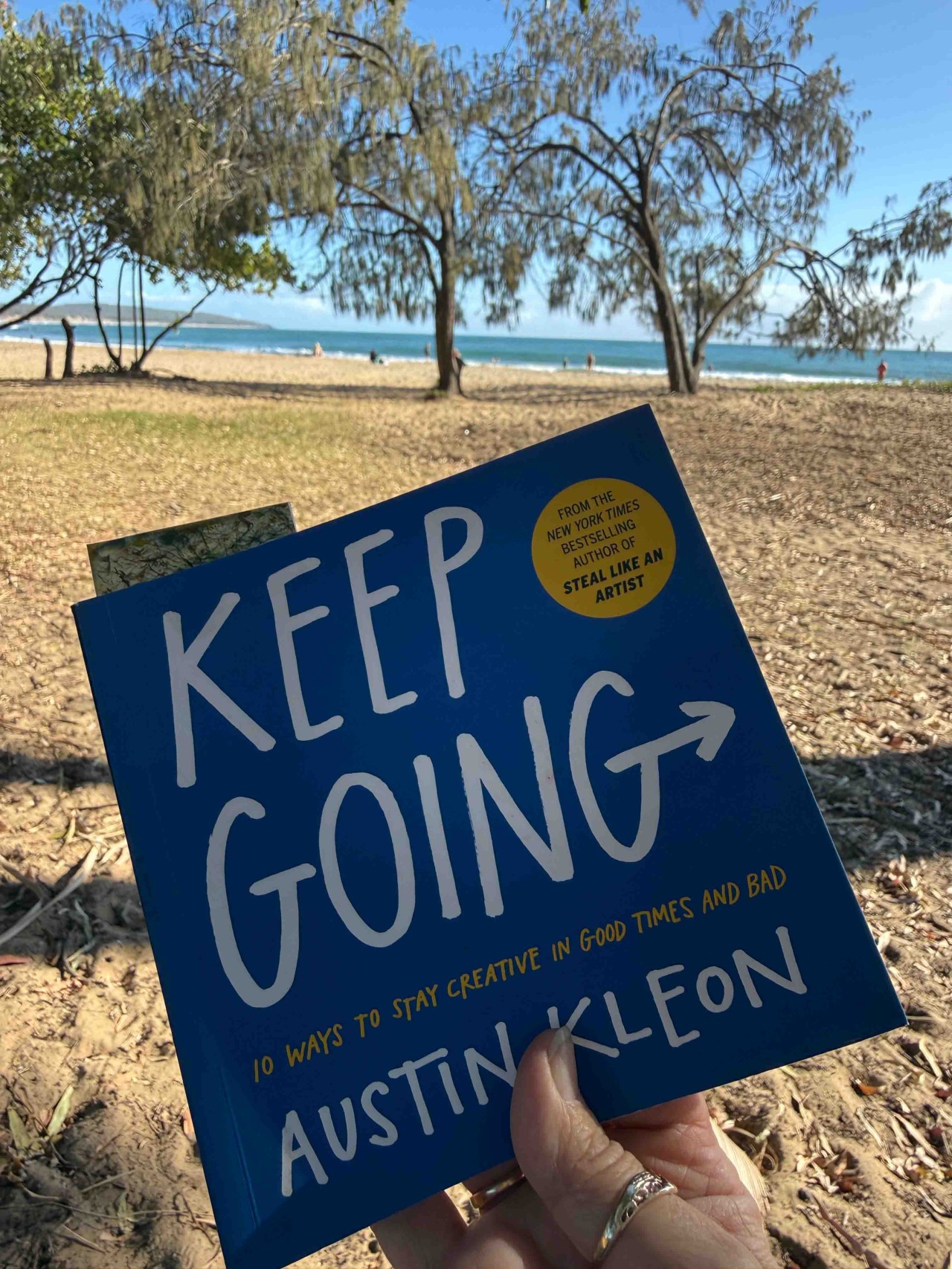
I’ve had Austin Kleon’s *Keep Going* sitting on my bookshelf for quite a while, and recently I finally sat down and really went through it — highlighter in hand, dog-earing pages as I went.
If you’ve read any of Austin Kleon’s books, you’ll know why I love them. *Steal Like an Artist*, *Show Your Work!* and *Keep Going* are small, easy-to-read books, but they’re packed with simple ideas that make you stop and think.
And I think that’s what I like most about them. They’re not overly complicated or trying to be deeply philosophical. They’re straightforward, practical and very relatable to anyone trying to live a creative life.
*Keep Going* is really about exactly what the title says: how do we keep creating through the ups and downs of life?
Here are some of the ideas that resonated most with me.
## Every Day is Groundhog Day
One of the first ideas in the book is that a creative life isn’t a straight line.
We tend to imagine we’re heading towards some magical destination. Perhaps when we can draw really well. When we sell our first painting. When we win an award. When we have an exhibition.
Then we’ll have “made it.”
But creativity doesn’t really work like that.
Every time we finish a painting, we start another one. Every time we learn something, there’s something else to learn. No matter how experienced you become, you keep returning to the beginning.
So rather than worrying too much about where all of this is leading, we can concentrate on what we can do **today**.
That might simply be sitting down for half an hour and drawing.
And this leads into something we talk about all the time in The Creative Barn — finding time.
## Find a Routine That Works for You
You don’t need somebody else’s perfect morning routine.
You need to look at your own life.
When do you have some space? When do you have the most energy? Are you an early riser? Do you work better at night? Could you find 20 minutes somewhere that you're currently losing to scrolling on your phone?
When I was working on paintings for an exhibition, I started getting up around 5:30 or 6am and going straight into the studio.
I’d draw for about an hour before I checked emails, turned on the computer, dealt with messages or headed outside to do the farm chores.
It was probably my most productive creative time.
Because once that computer went on… forget it.
You think, “I’ll just quickly check my emails.”
Then someone needs help with their membership. You answer that. A Facebook message pops up. You check Facebook. Five minutes later you’re scrolling through your feed and you’ve completely forgotten why you opened Facebook in the first place.
We've all been there.
The trick isn’t necessarily finding *more* time. Sometimes it’s protecting a little bit of the time we already have.
## I Am Definitely a List Person
Another part of *Keep Going* that made me laugh was Kleon talking about lists.
I LOVE a list.
Honestly, if I didn’t have lists, very little would happen around here.
I use Notion to keep track of what I need to do each day. When life gets particularly busy — like when I’m organising an art retreat — I’ll sometimes wake up during the night thinking:
*Did I pack that?*
*I need to remember this.*
*Don't forget to take that tomorrow!*
If I can't stop thinking about it, I grab my phone, put it on the list and then I can usually go back to sleep because it's no longer rattling around inside my head.
Lists can also be fantastic for your art.
Instead of finally getting two hours in your studio and spending the first 30 minutes wondering what you should work on, keep a list of paintings you want to create, subjects you want to draw, techniques you want to try or things you want to learn.
Then you've always got somewhere to start.
## Build Your Own Bliss Station
I really loved this idea.
Your “bliss station” is somewhere you can disconnect from everything else and reconnect with yourself.
It doesn’t have to be a beautiful purpose-built studio.
It could be your kitchen table.
A chair in the garden.
A corner where you keep your sketchbook.
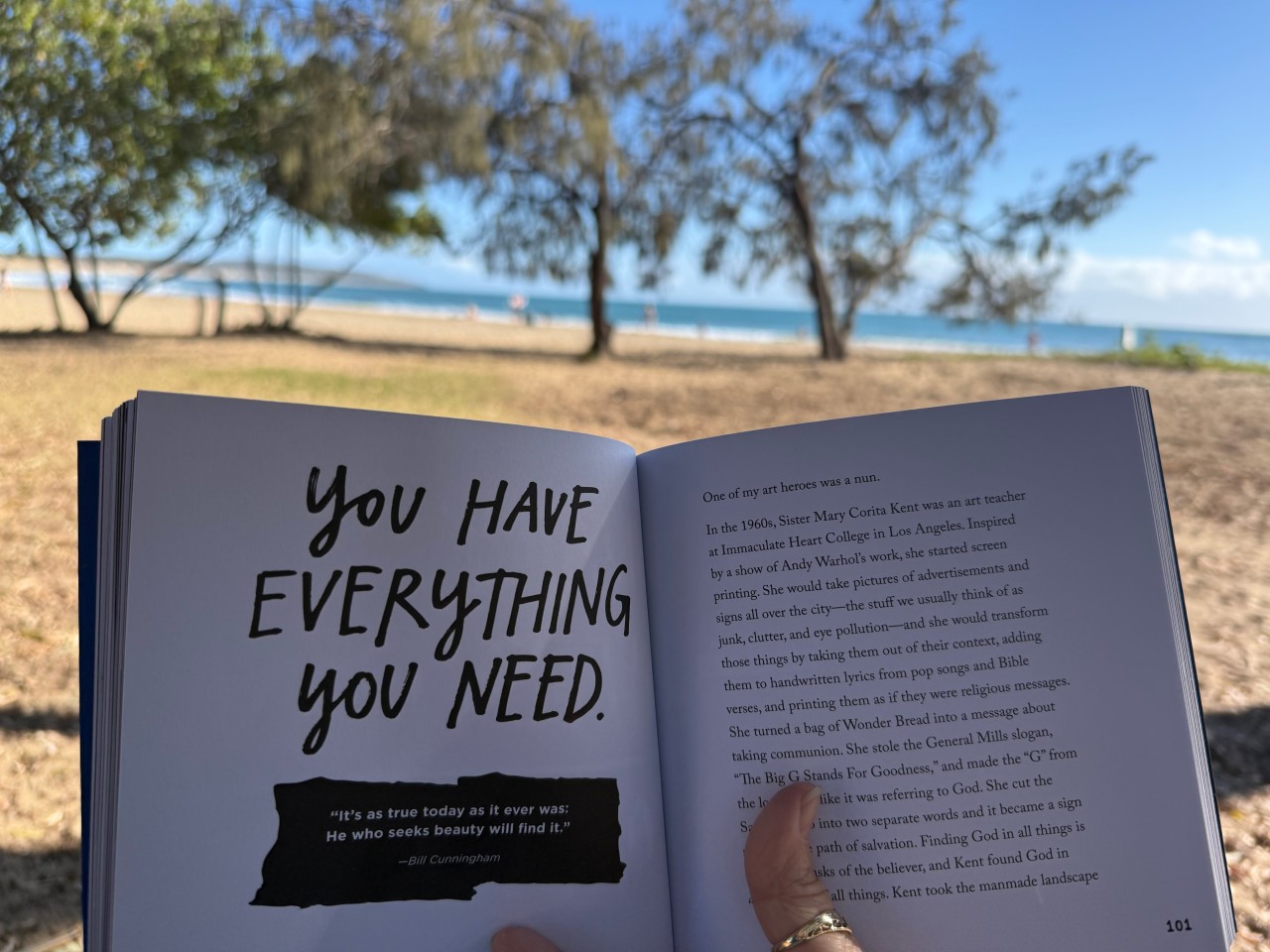
For me, one of those places is actually the beach. I love taking my chair down, finding some shade and simply sitting there looking out at the waves.
Your bliss station is somewhere the noise can stop for a little while.
And these days, there is a LOT of noise.
## Maybe We Need to Switch Off
I think those of us who grew up before the internet remember a very different world.
Your world consisted mainly of your family, your friends and the people around you. Maybe you watched the news for half an hour in the evening.
That was pretty much it.
Now we carry the entire world around in our pocket.
Obviously, I love the internet. I couldn't run an online art membership or sit and chat with artists all around the world without it.
But sometimes it is just too much.
News. Emails. Messages. Notifications. Social media.
And the minute we click on something, the algorithm decides, *Oh! You like that? Here's another 400 of them.*
One of my favourite suggestions from the book is treating **airplane mode as a way of life**.
We don't have to be on a plane to turn our phones off.
Maybe we could put them on airplane mode while we draw. Or while we're having our morning coffee. Or while we sit outside for half an hour.
Give your brain some space where nobody can get to you.
Your art might thank you for it.
## Your Real Work is Play
This was probably one of my favourite sections.
Watch a young child drawing.
They are completely involved in what they're doing, but often they couldn't care less about the finished result.
I've seen this with my own grandchildren.
They draw something and then they're ready for another piece of paper. I could hang the first drawing on the wall or throw it away and, particularly when they're little, they really don't care.
They enjoyed **making it**.
As adults, somewhere along the way we lose that.
We become obsessed with the result.
*It doesn't look right.*
*It's not as good as hers.*
*I ruined it.*
*I can't draw.*
And suddenly the thing we're supposed to be doing for enjoyment becomes another source of stress.
Of course we want to improve. Of course we'd like the finished painting to look good.
But did you enjoy making it?
Because that matters too.
## Not Every Hobby Needs to Become a Side Hustle
Now THIS section made me squirm a little.
Kleon talks about our tendency to see somebody who's good at something and immediately tell them they should sell it.
Someone knits a beautiful scarf.
“You could sell these!”
Someone makes an amazing cake.
“You should start a cake business!”
Someone paints something beautiful.
“You should sell your paintings!”
We think we're giving them a compliment.
And I'm guilty of this too.
I've done it with my daughter. She's had lots of different hobbies over the years and she's very good at them, so I immediately start thinking about how she could turn them into a business.
But this book made me think about that differently.
**Maybe some things are allowed to just be hobbies.**
The whole reason we start doing them might be because they help us relax and switch off. The minute we attach customers, deadlines, commissions and money to them, we've potentially added the stress straight back in.
This is particularly relevant with art.
Some artists desperately want to sell their work and build an art business, and I love helping them do that.
But plenty of artists don't.
And that's completely okay.
You are allowed to create art purely because you love creating art.
## Make Something as a Gift
This naturally leads into another idea I loved: make gifts.
If you're feeling flat or you've stopped enjoying your art, make something for somebody you love.
Don't worry about selling it.
Don't worry about posting it online.
Don't worry whether it fits your “style” or your body of work.
Just make something for someone.
There's something lovely about creating a piece while imagining the person opening it on their birthday, Mother's Day or Christmas.
Sometimes taking money and expectations out of the equation can reconnect us with why we enjoyed making things in the first place.
## The Ordinary Can Become Extraordinary
You don't need to travel to Africa to find an incredible wildlife subject.
You don't need the perfect landscape or an exotic animal.
There are extraordinary subjects all around us if we actually pay attention.
A bird sitting on a fence.
A beetle in the garden.
Interesting light falling across an animal.
A feather.
An old tree.
The expression on your dog's face.
Artists notice things other people walk straight past.
And then we get to take that ordinary little moment and say, **Look at this. Isn't this beautiful?**
That's one of the things I love most about being an artist.
## Slow Down and Actually Look
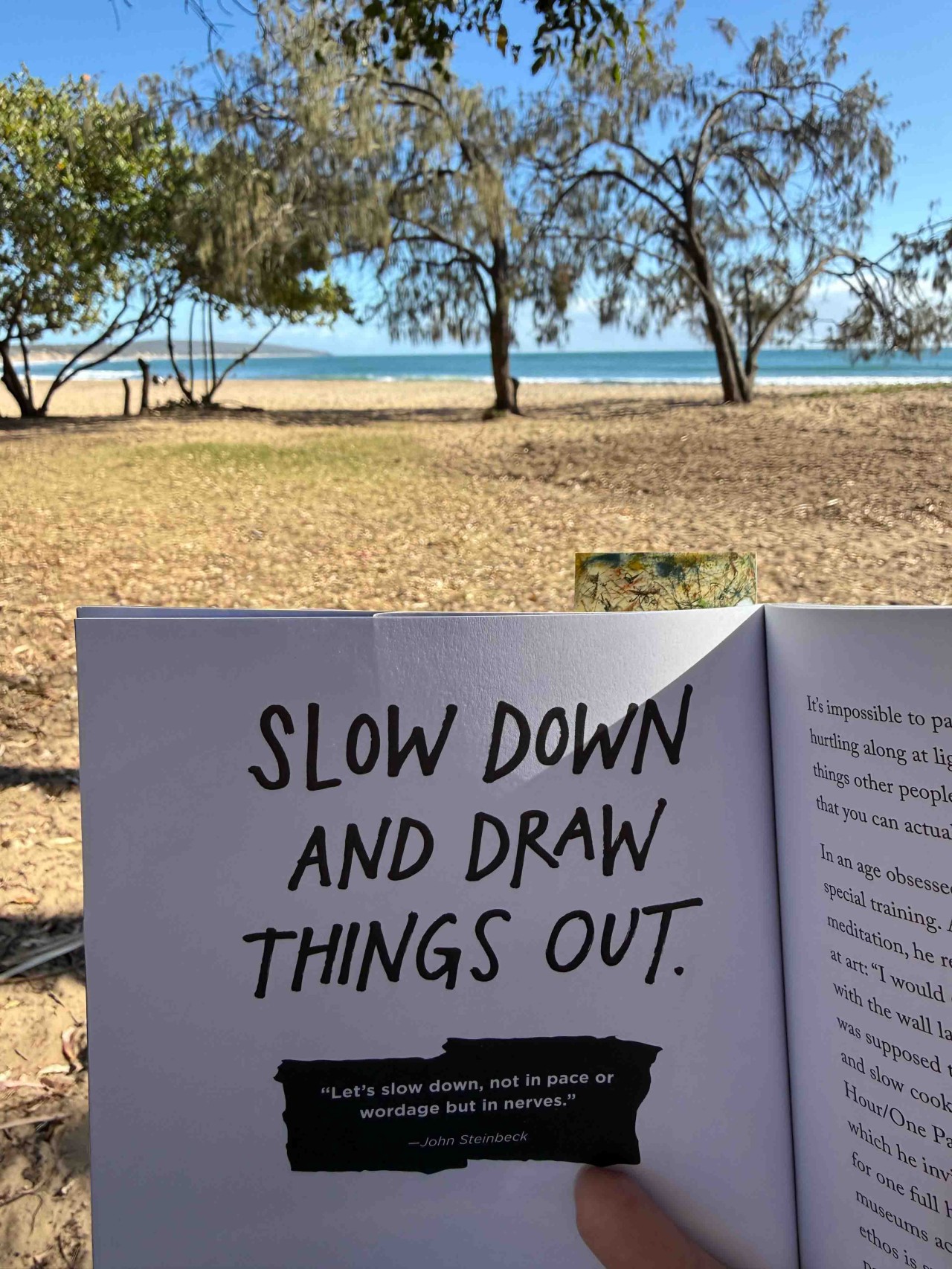
Drawing is one of the best ways I know to make yourself really look at something.
We see this constantly when we do gesture drawing in The Creative Barn.
We might only have 30 seconds to draw an animal, but suddenly we're noticing things.
*Look how long that leg is!*
*Look at those funny toes!*
*I never realised its ears did that.*
*Look how long its nose actually is.*
We're not just glancing anymore. We're observing.
You don't even have to be good at drawing to get this benefit.
Grab a pencil and a piece of paper, sit somewhere and draw what you see.
A pencil has one particularly wonderful feature that your phone doesn't:
**It can't send you a notification.**
## When in Doubt, Tidy Up
I was very pleased to discover that Kleon doesn't necessarily suggest we all become perfectly organised Marie Kondo types.
Because that isn't happening in my studio anytime soon.
Instead, he talks about tidying as a kind of productive procrastination.
And I completely understand this.
I'll go through a pile of papers and suddenly discover something I'd printed months ago.
“Oh! THAT'S where that went.”
Or I'll rediscover an idea I'd completely forgotten about.
The point isn't necessarily to create the world's cleanest studio. It's to reconnect with the things that are already sitting around you.
Sometimes rummaging through old sketches, unfinished paintings, reference photographs or forgotten ideas is exactly what you need to get moving again.
## Demons Hate Fresh Air
Another wonderfully simple idea:
**Go outside.**
When we've spent too long staring at screens, everything can start feeling a bit grim.
Then you walk outside.
There are birds.
Clouds.
Trees.
People going about their lives.
Animals doing ridiculous animal things.
The real world is still there.
For artists, walking also gives us the opportunity to notice. Take a little sketchbook or your camera with you. You don't have to go anywhere particularly exciting.
Just get outside and look.
## Creativity Has Seasons
This may be one of the most important messages in the book, particularly for anyone who feels as though they've lost their creative spark.
We have seasons in our creative lives.
Sometimes we're incredibly productive.
Sometimes we're learning.
Sometimes we're experimenting.
Sometimes we're gathering ideas.
And sometimes… not much seems to be happening at all.
That doesn't necessarily mean you've lost your creativity.
It may simply be the season you're in.
I particularly love that Kleon isn't obsessed with the young creative genius. He's much more interested in the person who keeps creating throughout their whole life.
And I think that's a wonderful message for artists.
**It is never too late.**
You don't have to have achieved everything by 30, 40, 50, 60 or 70.
I'd much rather still be creating, learning and getting excited about art when I'm 80 than worry about whether I'm ticking off some imaginary list of achievements quickly enough.
## Just Keep Going
And ultimately, that's what this whole book comes back to.
You don't need to have everything figured out.
You don't have to create a masterpiece today.
You don't have to sell your art.
You don't have to feel inspired every morning.
You don't even have to be particularly productive all the time.
Sometimes you just need to do the next small thing.
Draw for ten minutes.
Take your camera for a walk.
Clean up your art table.
Make something silly.
Turn your phone off.
Give somebody a drawing.
Notice a bird in your backyard.
Then tomorrow, you get another day.
I think that's why *Keep Going* resonated with me so much. None of the ideas are particularly complicated — and perhaps that's exactly why they're so useful.
We're often looking for some huge answer to staying motivated and creative.
Maybe there isn't one.
Maybe we simply have to give ourselves the space to play, pay attention to the world around us, stop putting so much pressure on the result…
…and keep going.