Social Media for Artists - Pinterest
 Kerri Dixon
Discover how Pinterest can help artists find inspiration, explore their style, organise ideas and share their artwork online.
Pinterest for Artists: Inspiration, Organisation and Getting Your Art Discovered
Over the past few weeks, we've been exploring how different social media platforms can be useful to us as artists.
We've talked about Instagram as our online portfolio, Facebook as our community, and YouTube as our free art school.
This week we're moving onto Pinterest, and I think this one is a little different again.
I like to think of:
Pinterest = Your Inspiration Board
But Pinterest has two sides for artists. It's a fantastic place to find and organise inspiration, but it can also be a powerful way for other people to discover your artwork.
And there's one very important copyright warning we need to talk about too!
Pinterest Isn't Really Social Media
Although we tend to lump Pinterest in with Facebook and Instagram, I think it's more helpful to think of it as a visual search engine.
When you open Instagram, you generally scroll through whatever appears in your feed.
On Pinterest, we're much more likely to search for something specific.
As an artist, that might be:
Teal and rust colour palette.
Dramatic wildlife lighting.
Still life composition ideas.
Animal portrait composition.
Art studio organisation.
Framing ideas.
You search for an idea and Pinterest gives you hundreds—sometimes thousands—of visual results to explore.
For artists, that's pretty amazing.
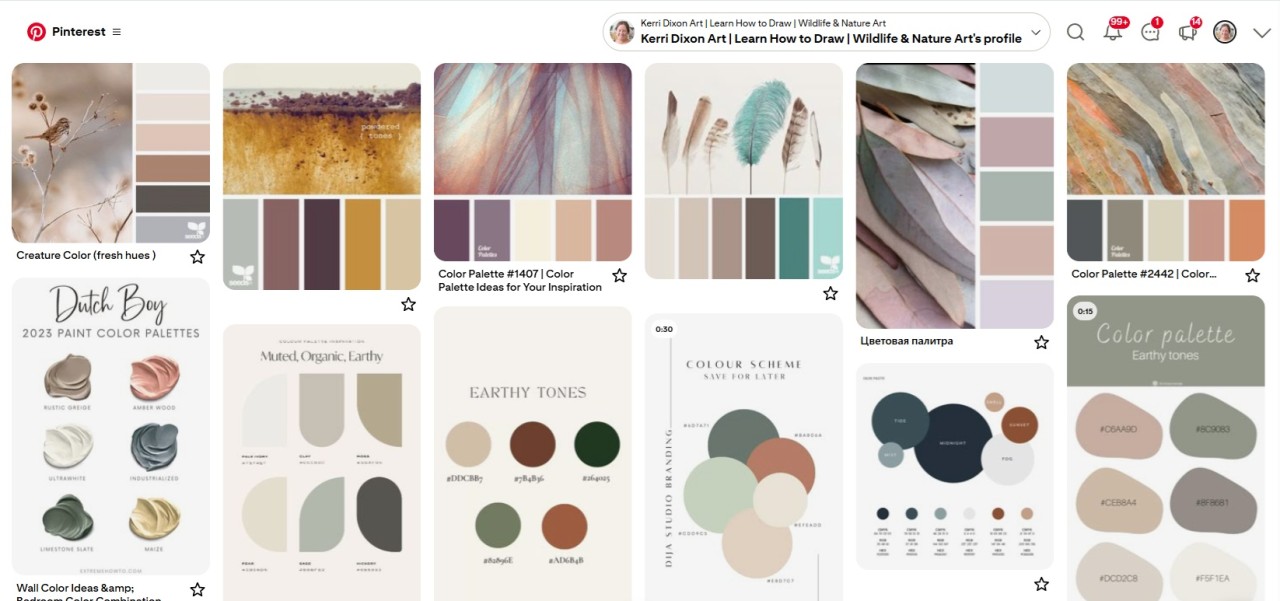
Your Giant Digital Inspiration Board
Remember when we used to cut pictures out of magazines and stick them into scrapbooks?
Pinterest is basically the enormous digital version.
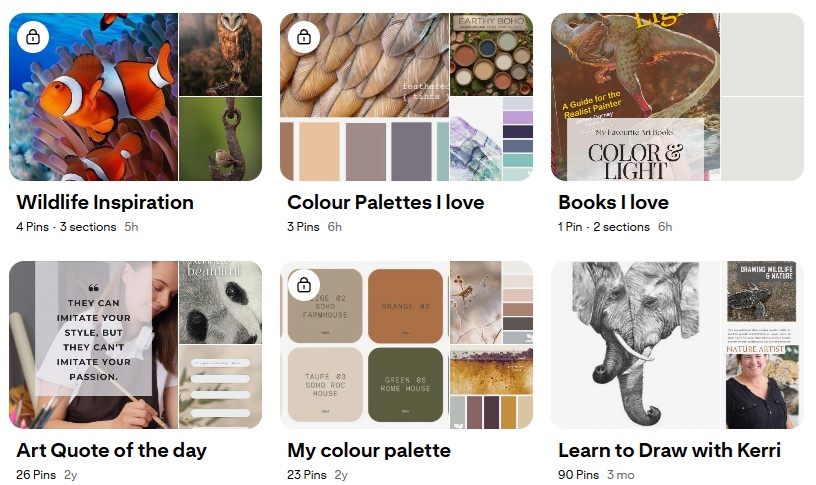
Instead of saving screenshots all over your phone and then never being able to find them again, you can organise things into Boards.
You might create boards for:
- Colour Inspiration
- Composition Ideas
- Beautiful Lighting
- Wildlife Inspiration
- Still Life Ideas
- Art Studios
- Framing Ideas
- Textures
- Future Painting Ideas
- Animals I'd Love to Paint
You can then organise things even further by creating sections within those boards.
For example, your Wildlife Inspiration board might contain sections for birds, horses, big cats and Australian wildlife.
Suddenly all those ideas you've been collecting actually become useful because you can find them again!
You Can Keep Boards Private
This is a feature I particularly like for planning artwork.
Not every Pinterest board has to be public.
You can create a private board for a particular painting or project and use it almost like a digital mood board.
Imagine you're planning your next wildlife painting.
You might save ideas for:
Lighting.
Colour palettes.
Backgrounds.
Composition.
Textures.
Framing.
You're gathering visual ideas before you even begin.
And because the board is private, it's simply your own little creative planning space.
BUT... A Very Important Warning About Reference Photos
This is probably the most important thing I want artists to understand about Pinterest.
Images on Pinterest are NOT automatically copyright-free.
This is something that can be very confusing.
Just because you can find an image on Pinterest doesn't mean you have permission to use that photograph as the reference for your next painting.
Pinterest contains images from websites, photographers, artists, businesses and publications all over the internet. The copyright doesn't disappear simply because someone has pinned the image.
So I wouldn't recommend searching Pinterest for a beautiful tiger photograph, copying it exactly into a painting and assuming it's okay because you found it on Pinterest.
Instead, use Pinterest for inspiration rather than direct reference.
Inspiration and Reference Are Two Different Things
This is such an important distinction for artists.
You might discover an image on Pinterest and think:
"I love that lighting."
Great!
Or perhaps:
"I love those colours."
Fantastic.
Maybe you love the way the animal has been cropped.
Or the amount of negative space.
Or the contrast between a warm subject and a cool background.
Those are all things we can learn from.
Rather than asking:
"How can I paint this image?"
Ask:
"What is it about this image that I like?"
That's a completely different way of looking at it.
You might save one image because you love the backlighting.
Another because you love its colour palette.
Another because the composition catches your eye.
Then you use those ideas alongside your own photographs or a reference image you have permission to use.
Now you're gathering inspiration rather than simply copying.
And that's much more interesting creatively anyway.
Use Pinterest to Study Composition
Pinterest can be brilliant for improving your understanding of composition.
Instead of searching for:
"Tiger reference photo"
try searching for:
"Dramatic wildlife composition."
Or:
"Animal portrait composition."
"Negative space composition."
"Backlit wildlife photography."
"Still life composition."
Then look at the results with your artist brain switched on.
Where is the focal point?
Where does your eye go first?
How much negative space has been left around the subject?
Where are the darkest darks and lightest lights?
How has the subject been cropped?
You're not looking for something to copy.
You're studying why an image works.
Pinterest Is Fantastic for Colour
This is probably one of my favourite uses for Pinterest.
Try searching for colour palettes.
Maybe you're planning a beach painting, so you search:
"Coastal colour palette."
Perhaps you're painting something rusty:
"Rust and teal colour palette."
Or you might search:
"Australian bush colour palette."
Suddenly you've got all these beautiful combinations you may never have considered.
Again, you don't have to copy anything.
You're simply filling your creative toolbox with ideas.
Now Let's Flip Pinterest Around
So far we've talked about using Pinterest to find things.
But what about letting other people find you?
This is where Pinterest becomes particularly interesting for artists who have a website, blog or online shop.
You can Pin your own artwork and link that Pin back to your website.
Someone might search Pinterest for wildlife art, discover your painting, click on it and end up on your website where they can see more of your work—or potentially even buy the painting.
Pinterest can become another little pathway leading people towards your art.
Your Artwork Has a Longer Life
This is another thing that makes Pinterest different from some other platforms.
When we post something on Facebook or Instagram, it often has its little moment in the sun and then gradually disappears down the feed.
Pinterest works through search and discovery, so useful or visually appealing Pins can potentially continue being found well after they were first posted.
And that's perfect for artwork.
Your beautiful horse painting doesn't suddenly become irrelevant because you painted it six months ago.
Someone searching for horse art can still be interested in it.
What Could Artists Pin?
If you'd like to start sharing your own work on Pinterest, you don't have to make it complicated.
You could share your finished artwork, close-up details, works in progress, sketchbook pages, step-by-step images, art tips, tutorials or blog posts.
And if you sell your artwork, you can also Pin pieces that are available and link people directly to your shop or website.
But if you're a hobby artist and have absolutely no interest in selling your work?
That's perfectly fine too.
You don't have to Pin your artwork at all.
You can simply use Pinterest as your own beautifully organised library of creative inspiration.
You Don't Have to Be Everywhere
This is something I want to reinforce throughout this whole Social Media for Artists series.
I'm not suggesting you now need to spend your entire life on Instagram, Facebook, YouTube and Pinterest.
Please don't!
The purpose of this series is to understand what each platform does well.
Then you can decide which ones actually add something useful to your art journey.
Maybe you love Instagram because you enjoy having somewhere to display your artwork.
Maybe Facebook gives you the community you need.
Maybe YouTube is where you go to learn.
And maybe Pinterest becomes the place you go when you're planning your next painting and need some inspiration.
Use the platforms that serve you.
You don't need to serve the platforms.
Use Pinterest to Collect Ideas, Not Artwork to Copy
If there's one thing I'd love you to take away from this week's chat, it's this:
Use Pinterest to collect ideas, not artwork to copy.
Collect colours.
Collect lighting.
Collect interesting compositions.
Collect textures.
Collect ideas that make you stop and think, "Ooh, I love that!"
Then ask yourself why you love it.
Take those little sparks of inspiration back to your own artwork and combine them with your own experiences, your own reference photographs and your own creative decisions.
Because ultimately, Pinterest shouldn't tell you what to paint.
It should get you excited about what you might create next.
Kerri xx