The Great Art Myth: Did the Old Masters Really Draw Everything Freehand?
 Kerri Dixon
Think tracing is cheating? Discover how artists have used grids, transfers, and drawing aids throughout history.
The Great Art Myth: Did the Old Masters Really Draw Everything Freehand?
One of the most common things I hear from artists is:
"I feel like I'm cheating if I use line art."
Or:
"I should be able to draw it freehand."
Or perhaps:
"Real artists don't trace."
If you've ever had those thoughts, you're not alone. In fact, I hear them regularly from students who are learning to draw and paint realistic animals.
But recently, one of my students returned from a trip through France and Italy after visiting museums, galleries, and historic art sites. One of the things that surprised her most was learning that many of the great masters of art history didn't necessarily create every drawing freehand from start to finish.
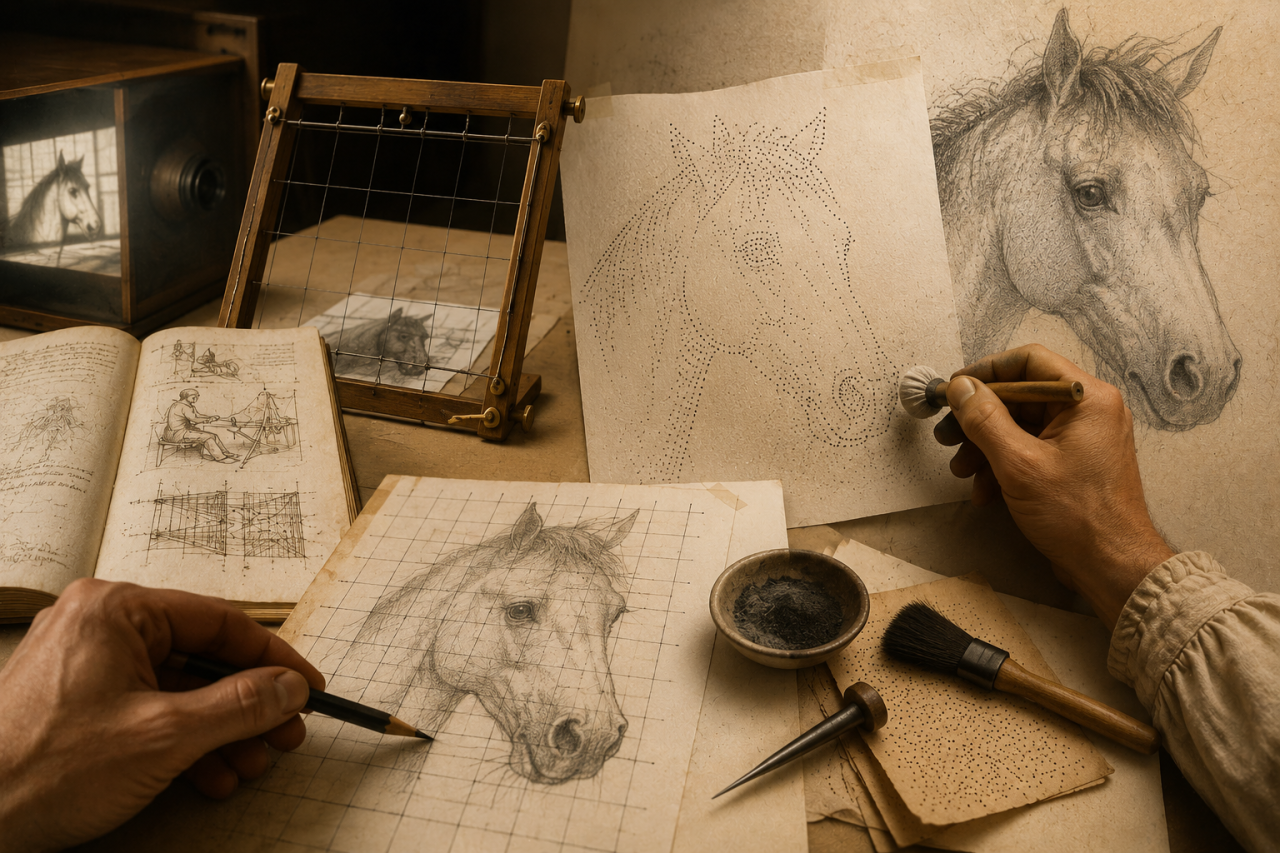
They used assistants. They used grids. They used transfer methods. They used optical aids. And they often relied on practical systems to help them create the incredible works we admire today.
That got me thinking about how much pressure modern artists place on themselves and how many of us are carrying around myths about what it means to be a "real artist."
So let's explore the fascinating history of how artists have been getting their initial sketches onto paper, canvas, walls, and ceilings for centuries.
The Myth of the Lone Genius
When we picture famous artists from history, we often imagine them working alone in a studio, effortlessly creating masterpieces from nothing.
We picture a gifted artist standing in front of a blank canvas and magically producing a perfect drawing.
The reality was often much less romantic and far more practical.
For much of history, successful artists operated workshops. These workshops functioned much like small businesses.
An apprentice might spend years learning the trade by helping prepare canvases, mix pigments, transfer drawings, paint backgrounds, and assist with larger projects.
Artists such as Raphael and Rubens employed teams of assistants who helped bring their ideas to life.
The master artist was still responsible for the design, composition, and final quality of the work, but they weren't necessarily completing every single step themselves.
This was especially important when creating massive murals, church ceilings, and large commissions that needed to be completed within a certain timeframe.
The focus wasn't on proving that every line had been drawn freehand.
The focus was on creating exceptional art.
The Ancient Grid Method
One of the oldest tools artists used was the grid.
The process is simple.
A drawing is divided into a series of squares, and the artist recreates those squares on a larger surface.
By working one square at a time, complex images can be enlarged accurately without losing proportions.
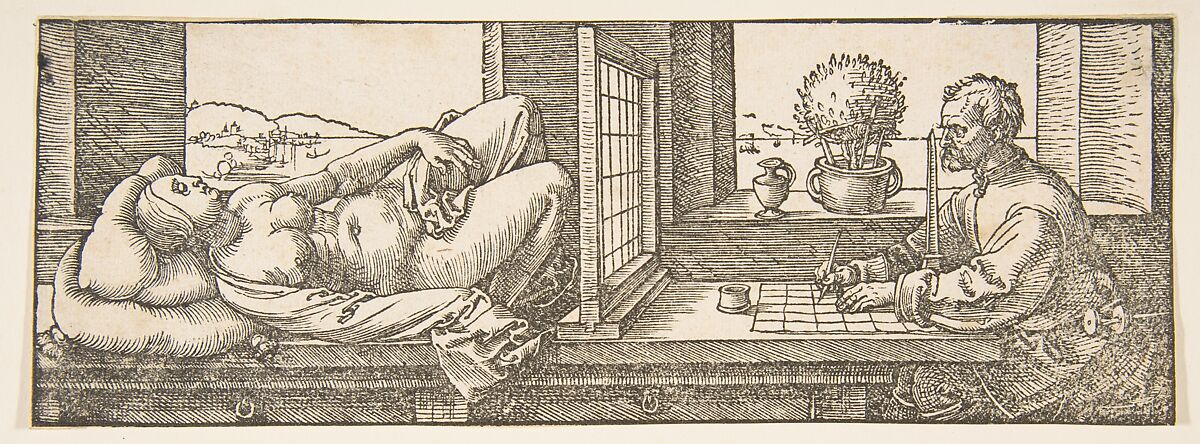
Many artists still use this method today.
In fact, if you've ever enlarged a reference photo using a grid, you're following a tradition that stretches back hundreds of years.
The grid wasn't considered cheating.
It was simply a practical tool that helped artists achieve accurate results.
After all, if an artist had spent weeks developing a beautiful composition, why would they risk ruining it by guessing proportions on the final canvas?
Pouncing: The Renaissance Transfer Method
One of my favourite historical techniques is called pouncing.
As a former signwriter, this one always makes me smile because it's essentially the same process we used in the trade.
Artists would first create a full-size drawing known as a cartoon.
The lines of the drawing would then be pricked with tiny holes using a sharp needle.
The cartoon would be placed on the final surface and charcoal dust rubbed across the back.
When the paper was removed, a dotted outline remained on the wall, canvas, or panel.
The artist simply joined the dots and began painting.
Sound familiar?
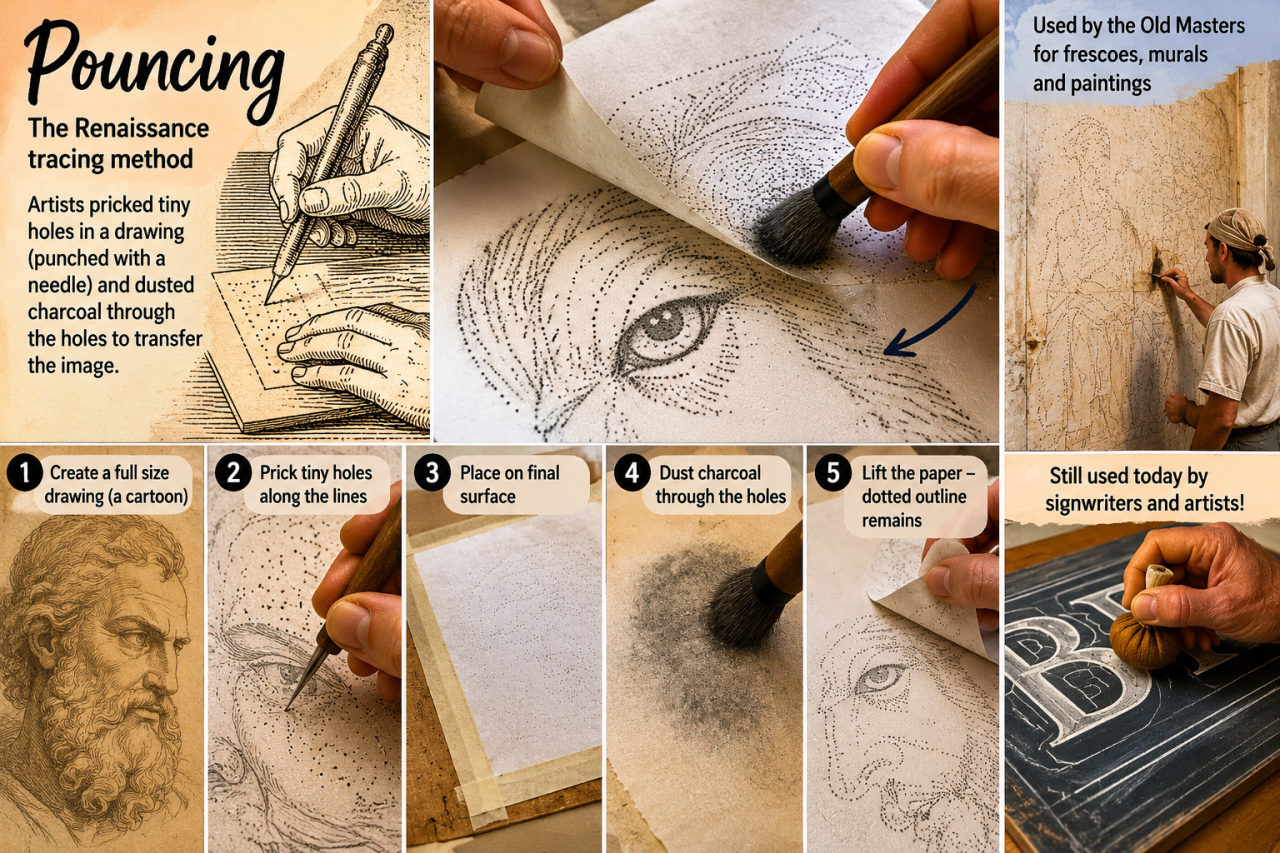
Many signwriters used exactly the same method to transfer lettering and designs onto signs before the days of digital cutters and printers.
Yet when we see Renaissance artists using it, we call it a historical technique.
When a modern artist uses tracing paper, some people call it cheating.
The irony is hard to ignore.
Dürer's Drawing Machines
One of the most fascinating artists in history was Albrecht Dürer.
Not only was he a brilliant artist, but he was also deeply interested in mathematics, measurement, and perspective.
Dürer created illustrations showing artists using various drawing devices and measuring systems.
Some involved strings stretched across a frame.
Others used sighting devices to help artists accurately record what they observed.
When you look at these illustrations today, they almost resemble early versions of modern drafting equipment.
The goal wasn't to avoid learning.
The goal was accuracy.
Artists were constantly searching for better ways to translate what they saw into drawings.
Optical Devices and the Camera Obscura
Long before photography existed, artists experimented with optical devices.
One of the most famous examples is the camera obscura.
This device projects an image onto a surface, allowing artists to study light, perspective, and detail in a new way.
There is ongoing debate about exactly how much some artists relied on these devices, but there is little doubt that artists throughout history were curious about new technologies and experimented with them whenever possible.
Artists have always embraced innovation.
Whether it was a camera obscura in the 1600s or a digital projector today, the motivation remains the same: finding better ways to create.
The Real Skill Comes Afterwards
This is the point I think many artists miss.
A transfer method can help you place a horse's eye in the correct location.
A grid can help you position a dingo's ears accurately.
A projector can help you get the proportions of a bird right.
But none of those tools can teach you:
- Value
- Edges
- Colour temperature
- Texture
- Light
- Composition
- Atmosphere
Those are the skills that transform a drawing into a beautiful artwork.
In my own teaching, I often provide line art because I want students to focus on the lesson being taught.
If we're learning about fur texture, I want students concentrating on fur texture.
If we're learning about values, I want them concentrating on values.
If a student spends three hours struggling to transfer a drawing and then runs out of energy before the actual lesson begins, they've missed the opportunity to learn the skill I was trying to teach.
The line art simply gets them to the starting line faster.
Why We Feel Guilty About Using Tools
So where does this guilt come from?
I suspect social media plays a role.
We see artists posting beautiful freehand sketches and assume that's what every artist should be doing.
We compare our behind-the-scenes process to someone else's highlight reel.
The reality is that professional artists use tools all the time.
Reference photos.
Viewfinders.
Proportional dividers.
Tracing paper.
Projectors.
Photo editing software.
Composition studies.
Colour swatches.
Artists have always used tools.
The tools have simply evolved.
Focus on the Finished Artwork
The Old Masters weren't obsessed with proving they could draw freehand.
They were focused on creating work that moved people.
They studied anatomy, light, perspective, storytelling, composition, and design.
They used whatever methods were available to help them bring their ideas to life.
Perhaps we should do the same.
Instead of asking ourselves:
"Did I draw this freehand?"
Maybe we should ask:
"What did I learn while creating this?"
"Did I improve?"
"Did I enjoy the process?"
"Did I create something I'm proud of?"
Because at the end of the day, the viewer rarely asks how the drawing got onto the paper.
They respond to the finished artwork.
And if using a grid, line art, tracing paper, or another transfer method helps you keep creating, then you're following a long tradition used by artists for centuries.
The Old Masters might have had different tools, but they were solving exactly the same problems we are today.
If you'd like to learn to draw animals in soft pastel, charcoal and graphite, then I invite you to follow THIS LINK to check out my online art classes inside The Creative Barn Membership.